
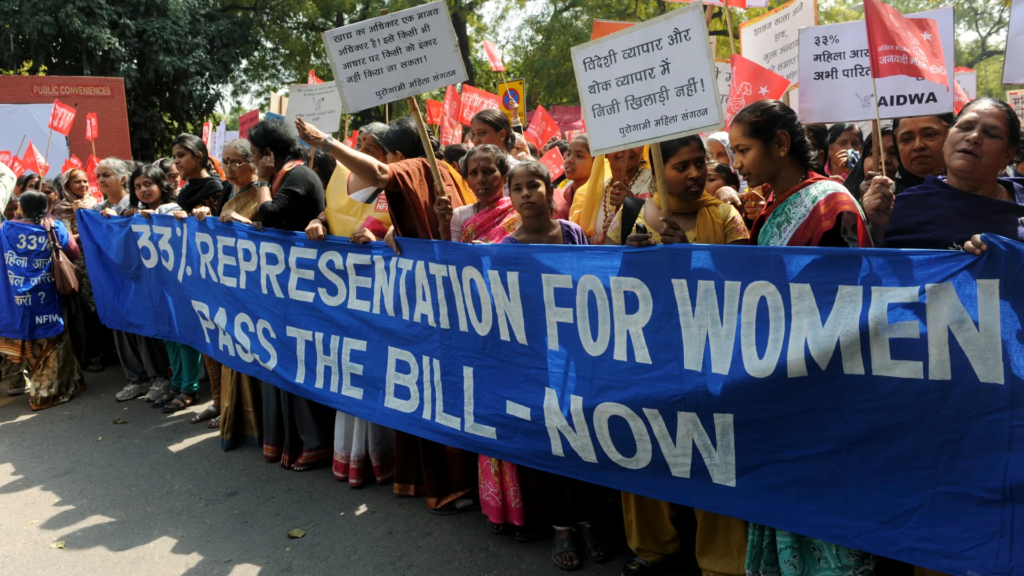
India’s promise of giving women 33% reservation in Parliament is once again at the center of a major political fight.
Women’s reservation moved back into national debate after the Modi government’s latest attempt to speed up implementation failed in the Lok Sabha last week. The Constitution (131st Amendment) Bill, 2026, which aimed to make the reservation effective before the 2029 general elections, did not get the required two-thirds majority in Parliament.
The original women’s reservation law, passed in 2023, still cannot be implemented immediately. Although the law officially came into force on April 16, 2026, it is tied to a future Census and delimitation exercise, meaning women may still have to wait years before they actually receive 33% of Lok Sabha and state assembly seats.
Collapse Of The 131st Amendment
The Constitution (131st Amendment) Bill was introduced during the special Parliament session held from April 16 to April 18. The government wanted to use 2011 Census data to begin delimitation immediately and expand the Lok Sabha from 543 seats to around 850 seats.
According to the government, expanding Parliament would have created enough additional constituencies to reserve 33% of seats for women before the 2029 elections. However, the bill failed badly in the Lok Sabha. Of the 528 members present and voting, only 298 supported the bill while 230 opposed it, far below the two-thirds majority needed for a constitutional amendment.
Once the main amendment bill failed, the two other linked bills, the Delimitation Bill, 2026 and the Union Territories Laws Amendment Bill, also collapsed. It marked the first major constitutional amendment defeat for the Modi government since 2014.
The Delimitation Dispute
Almost every political party publicly supports the idea of women’s reservation. The real disagreement is over delimitation.
Delimitation is the process of redrawing parliamentary constituencies based on population changes. Southern states such as Tamil Nadu, Kerala, Karnataka, and Andhra Pradesh strongly opposed the government’s plan because they fear a new population-based seat distribution would shift political power toward northern states with larger populations.
Opposition parties argued that the government was using women’s reservation as a cover for a much larger political restructuring. Congress leaders described the bill as “delimitation in disguise” and said women’s reservation should be implemented within the current 543-seat Lok Sabha instead of being tied to future seat redistribution.
DMK MP P Wilson has already introduced a separate private member’s bill seeking immediate 33% reservation for women without waiting for Census data or delimitation.
Women Still Wait For Reservation
The 2023 women’s reservation law is already legally valid. But under Article 334A, it can only be implemented after the first Census conducted after 2026 and the delimitation exercise based on that Census.
Because of that timeline, the reservation may not become reality until well after the next general election. Some policy experts believe women may not see 33% representation in Parliament before 2034.
Women currently make up only around 13.6% of the Lok Sabha. In the 2024 elections, only 74 women were elected to the 543-member House.
India has already passed the law, notified it, and publicly committed to giving women more political power. But until the Census and delimitation process moves forward, the promise remains stuck between legal approval and political reality. For now, women have the law on paper. They still do not have the seats.