
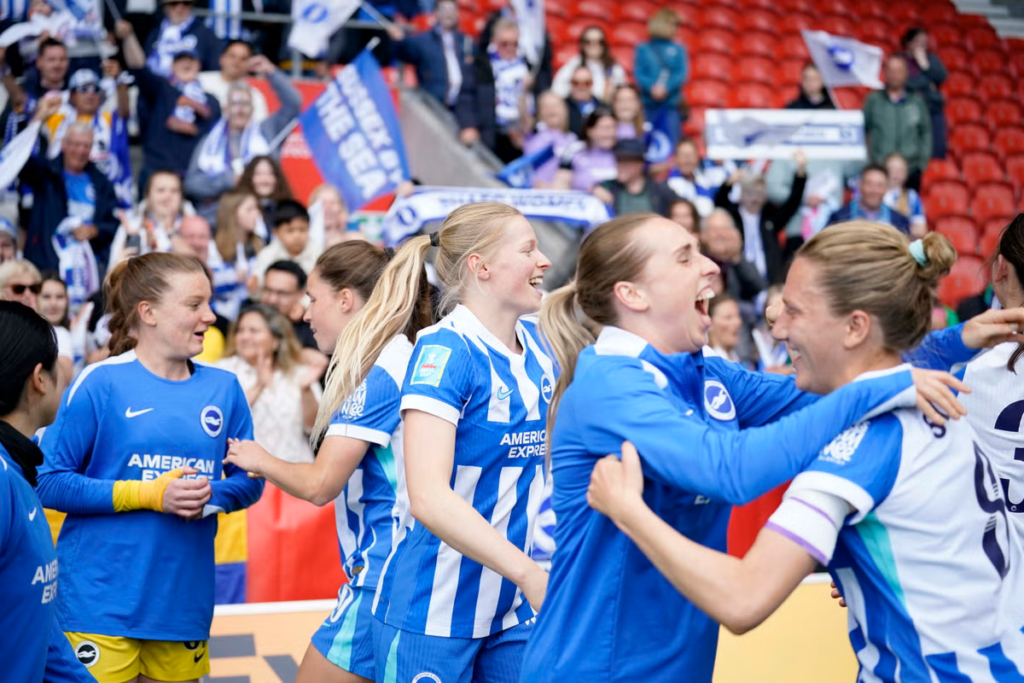
Brighton & Hove Albion Women produced one of the most dramatic moments of the 2026 Women’s FA Cup after fighting back from two goals down to defeat Liverpool FC Women 3-2 and reach the final for the first time in club history. The semi-final at St Helens Stadium looked nearly over within the opening 22 minutes after Liverpool took early control, but Brighton responded with relentless attacking pressure before substitute Nadine Noordam scored a stunning 95th-minute winner to send the club to Wembley Stadium. The comeback is already being seen as one of the biggest moments in Brighton Women’s history and another sign of the growing popularity and competitiveness of women’s football in England.
Liverpool started the match strongly and dominated the early stages with fast attacking moves and aggressive pressing. Denise O’Sullivan opened the scoring in the 11th minute after connecting with a cross from Ceri Holland before Beata Olsson doubled Liverpool’s lead shortly afterward following a defensive mistake inside Brighton’s penalty area. At 2-0 down, Brighton appeared close to another disappointing semi-final exit after previously falling short in the competition in both 2021 and 2023.
Brighton’s Stunning Fightback
The momentum of the game changed only moments after Liverpool’s second goal when Brighton defender Manuela Vanegas scored from close range following a corner kick. The goal immediately lifted Brighton’s confidence and shifted pressure back onto Liverpool before halftime. Brighton returned for the second half with greater intensity, stronger pressing, and far more control in midfield as Liverpool struggled to slow down the pace of the game.
Brighton’s equalizer came in the 54th minute when Madison Haley headed home from a Kiko Seike cross after sustained pressure around Liverpool’s box. Match statistics later reflected Brighton’s dominance during the comeback. Brighton finished with 16 total shots compared to Liverpool’s 11 while also registering seven shots on target during the semi-final. Liverpool managed only three attempts during the second half as Brighton increasingly controlled possession and attacking momentum.
Goalkeeper Chiamaka Nnadozie also played a major role in Brighton’s victory after making several important saves late in the game, including a key stop against Cornelia Kapocs that prevented Liverpool from retaking the lead. As the match moved toward extra time, Brighton continued pushing forward while Liverpool struggled to regain control under growing pressure.
Noordam’s Historic Winner
With extra time looking almost certain, Brighton finally completed the comeback deep into stoppage time after sustained pressure inside Liverpool’s penalty area created chaos in the closing moments. The loose ball eventually fell to substitute Nadine Noordam, who had entered the match only minutes earlier. The Dutch midfielder calmly controlled the ball before firing a powerful finish into the net from close range, instantly sending Brighton players and supporters into emotional celebrations.
The goal secured Brighton Women’s first-ever appearance in a Women’s FA Cup final and marked one of the biggest achievements in the club’s history. Under head coach Dario Vidosic, Brighton has become one of the fastest-improving teams in English women’s football this season. The club has remained unbeaten since mid-March while also recording major results against Arsenal and Liverpool during its FA Cup run.
Global Attention on Wembley
Brighton will now face Manchester City Women in the 2026 Women’s FA Cup final at Wembley Stadium on May 31 after City defeated Chelsea 3-2 in extra time in the other semi-final. Manchester City recently secured the Women’s Super League title and will enter the final as favorites, but Brighton’s remarkable run has already shown how quickly the competitive level in women’s football is changing.
The upcoming final is expected to attract major international attention as women’s football continues seeing growth in attendance, sponsorship investment, broadcasting deals, and online engagement across Europe. Brighton’s dramatic victory against Liverpool is now being viewed as more than just a semi-final upset. It has become another example of how women’s football is entering a new era where emerging clubs are increasingly capable of competing with the traditional giants of the game.