
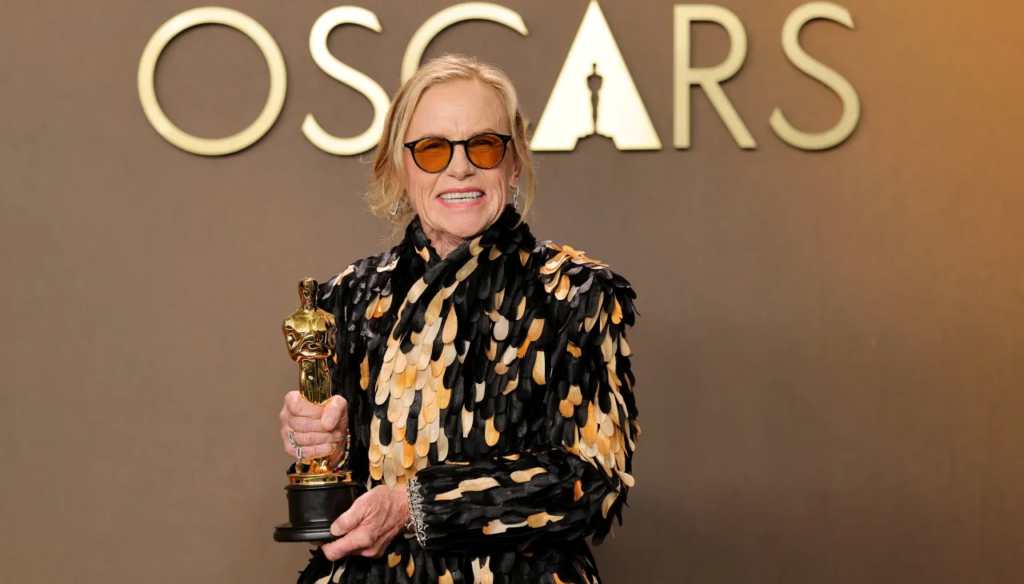
Amy Madigan has won her first Academy Award for Best Supporting Actress at the 98th Oscars on March 15, 2026, for her role in Weapons, marking a defining moment in a career that has spanned more than four decades. This recognition comes 40 years after her earlier nomination for Twice in a Lifetime.
At the age of 75, her win stands out in an industry where awards are often associated with peak visibility and continuous recognition. It reflects a career that continued steadily over time, even when it was not consistently part of mainstream award conversations.
Career Shift After First Nomination
Madigan gained early attention in the 1980s when she received her first Academy Award nomination. At that stage, her career appeared aligned with a trajectory of continued recognition.
However, that momentum did not translate into long-term visibility within the awards space. While she remained active in films such as Field of Dreams and Uncle Buck, along with television and stage work, she was not consistently included in major award discussions.
This shift reflects a broader pattern within the industry, where early recognition does not always lead to sustained visibility, particularly for women as opportunities evolve over time.
A Career Built on Consistency
What defines Madigan’s journey is continuity. She continued to work across a wide range of roles without relying on awards recognition as a measure of success.
Her career developed through steady contributions rather than a series of high-profile moments. This reflects a reality seen across many professions, where consistent work does not always receive equal visibility or recognition.
Her Oscar win brings attention to this type of career path, one that is often overlooked but remains essential to the industry.
The Role in Weapons
In Weapons, Madigan played Aunt Gladys, a character defined by intensity and presence. The role was not heavily promoted in advance, and the film itself was not positioned as a traditional awards contender.
Once released, her performance became a central point of discussion among audiences. The response developed organically, driven by how strongly the character resonated rather than by marketing efforts.
This highlights a shift in how recognition is shaped today. Strong performances can still gain attention through audience engagement and critical response, even without large promotional campaigns.
Beyond the Oscar Win
Madigan’s Oscar win carries significance beyond a single achievement. It highlights how recognition does not always follow a fixed timeline.
Her journey shows that careers can evolve over long periods and still reach moments of acknowledgment later. It also places her among the few actresses whose work has been recognised at a stage where opportunities are often more limited.
At the same time, her win reflects a broader reality within the industry, where recognition is influenced by visibility, timing, and access to roles, not just performance.
Conclusion
Amy Madigan’s Oscar win is not just about a long wait. It is about a career that continued without guarantees and reached recognition on its own timeline.
It challenges the idea that success must follow a predictable path or remain tied to early achievements. Instead, it highlights the value of consistency and long-term commitment.
Her journey offers a different perspective on success, one that is built over time and recognised when the moment aligns, rather than when it is expected.