
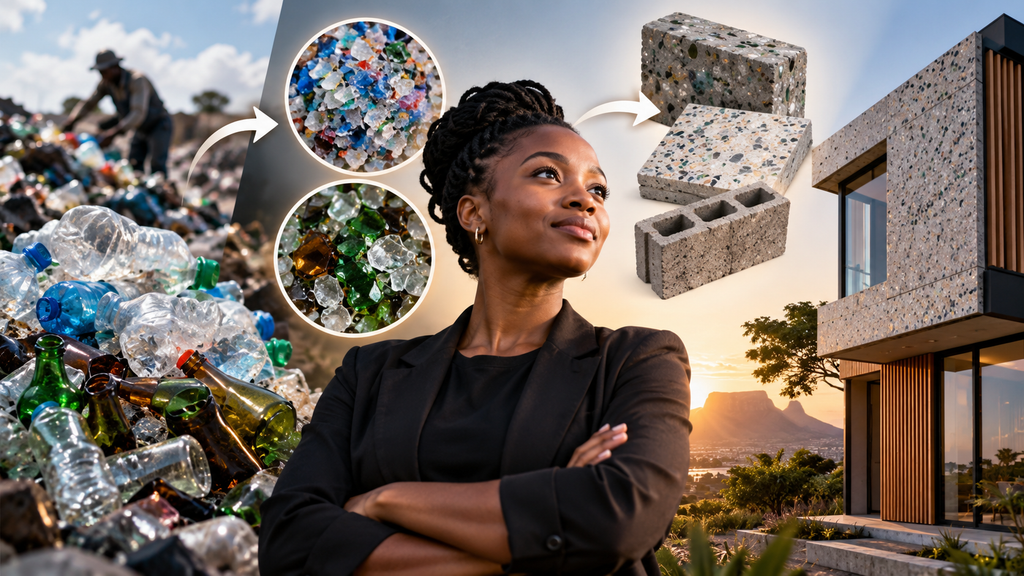
Across many cities, waste is part of the landscape long after its useful life has ended. Plastic, glass and other discarded materials collect around communities, while managing them remains a growing challenge. Yet the same waste can take on a different value when someone finds a practical use for it.
In Kimberley, South Africa, Zimkhitha Duze is building a business around that idea. Through Uuka Bricks, she is turning recycled waste into building materials while working at the meeting point of waste management, construction and local manufacturing.
The idea may sound simple, but making it work as a business is harder. Waste must be collected and prepared in a steady way. The finished products must meet the needs of the construction market. A small business also needs the right machines, space, funding and customers to grow. That gap between an idea and a working manufacturing business sits at the centre of Duze’s story.
Uuka Bricks’ Beginnings in Kimberley
Duze has a background in finance, but the idea for Uuka Bricks came from what she saw after returning to Kimberley. Unemployment and waste were both clear problems in the community. She began thinking about whether the two could be linked through a business.
Instead of seeing waste only as an environmental problem, Duze saw it as a possible raw material. That thinking led to Uuka Bricks, a Kimberley-based business that makes eco-bricks and hollow cement blocks from recycled and non-biodegradable materials.
The Motsepe Foundation has identified plastic and glass among the waste materials used by the business. Visa describes Uuka Bricks as an eco-friendly brick manufacturer using waste to address plastic pollution and housing needs.
The business model goes beyond collecting waste. The material has to move through a process that turns it into something useful and saleable. That makes production, consistency and customer demand just as important as the environmental purpose behind the idea.
Recycled Waste in Building Materials
In 2025, Uuka Bricks was using a compact brick-making machine. Diamond Fields Advertiser reported that one of its brick mixes contained about 30% plastic, along with sand and cement. The company was also making stock, maxi and hollow bricks.
Those details describe the business at that stage. They should not be treated as a confirmed 2026 production formula because the process can change as equipment and production methods develop.
The wider waste picture shows why the idea has room to grow. Plastics SA reported that 485,000 tonnes of plastic were recycled in South Africa in 2025, with an output recycling rate of 30.1%. Glass has its own recycling gap. Research published in the South African Journal of Science in 2026 estimated that about 282,000 tonnes of glass from roughly 423,000 tonnes of bottles sold each year were not recycled.
For Uuka Bricks, the question is practical: can waste become a steady source of material for a manufacturing business?
Duze’s Recognition Across South Africa
Duze has gained national attention while Uuka Bricks is still growing.
In 2025, Uuka Bricks placed second in Visa and Absa’s She’s Next South Africa competition and received R270,000. It also won the programme’s Impact Award, worth another R100,000. Visa highlighted the company’s use of waste to create building materials while addressing environmental and housing needs.
The recognition continued in 2026. Duze was named among the Future 54 honourees recognised by Director Woman. Her profile also highlighted plans to expand Uuka Bricks across South Africa and later into other African markets.
In August, Duze reached another national stage as one of 10 finalists in Standard Bank’s 2026 Kasi SME National Pitch Challenge. She represented the Northern Cape at the national final in Gqeberha.
She did not win the R1 million prize. Rodney Maduwa’s Maduwa Paint World took the award. Duze’s place among the finalists adds to Uuka Bricks’ growing profile, but it does not mean the company has already reached large-scale production.
The Challenge of Scaling Uuka Bricks
The harder part of Duze’s journey now sits inside the factory, not on the awards stage.
Earlier reporting covered her efforts to find a permanent production site. More recent coverage has highlighted plans for automated or hydraulic machines, larger premises and full commercial production.
These needs show what it takes to turn an environmental idea into a business. A product can have a clear purpose and still struggle if production is slow, equipment is limited, raw materials are hard to source or customers cannot be served in the required volume.
Uuka Bricks therefore needs more than access to waste. It needs a steady supply of material, better equipment, suitable space, funding and a market for its products.
Duze’s finance background adds another useful layer to this challenge. As the business grows, capital has to be used carefully. Equipment, premises and production systems all compete for limited funds. The right investment can unlock the next stage of the business, while the wrong one can leave a young manufacturer with higher costs but little extra output.
Can Uuka Bricks Grow Across Africa?
South Africa’s waste policy places greater focus on recycling, keeping waste out of landfills and creating economic value from discarded materials. Uuka Bricks fits within that wider effort, but its future depends on whether the business can make its model work beyond Kimberley.
Duze has expressed plans to take Uuka Bricks across South Africa and into other African markets. That would bring new demands. Construction rules, waste systems, supply chains, customer needs and access to finance can differ from one market to another.
The product may be a brick, but the bigger task is building the system around it. That means finding reliable inputs, keeping production steady and reaching customers at a scale that supports the business.
Duze’s Vision for Uuka Bricks
Duze’s story shows what sustainable entrepreneurship looks like when the idea has to survive outside a pitch competition.
Plastic and glass waste can be reused. That part of the proposition is easy to understand. The harder question is whether the process can support steady production, paying customers and jobs.
Uuka Bricks began with problems Duze could see in her own community. The business has since gained national recognition and reached major entrepreneurship platforms. Its next progress will be measured less by awards and more by what happens inside the operation.
More capable machinery, reliable production, repeat customers and stronger business systems will show whether the idea can become a lasting manufacturing company.
Duze is building Uuka Bricks from Kimberley with a larger ambition in mind. Her journey is now about more than turning waste into building materials. It is about proving that an overlooked waste stream can support a real business and that a local manufacturing idea can find a market beyond its starting point.
Frequently Asked Questions
1. What is Uuka Bricks known for?
Uuka Bricks is known for producing building materials from recycled and non-biodegradable waste. The business uses materials including plastic and glass as part of its waste-based approach.
2. How much plastic has Uuka Bricks used in its bricks?
A 2025 report described one Uuka Bricks mixture as containing about 30% plastic, along with sand and cement. This reflects the production stage reported at that time, not a confirmed 2026 formula.
3. What recognition has Zimkhitha Duze received?
Duze placed second in Visa and Absa’s She’s Next South Africa competition in 2025 and also received its Impact Award. In 2026, she became a Future 54 honouree and a national finalist in Standard Bank’s Kasi SME National Pitch Challenge.
4. What challenges does Uuka Bricks face as it grows?
The business needs better machinery, larger premises, reliable waste supplies and funding to move towards commercial production. Steady customer demand will also be important as production increases.
5. Can Uuka Bricks expand beyond South Africa?
Duze has expressed plans to expand across South Africa and into other African markets. Success would depend on local waste supply, construction needs, production systems, funding and market demand.