
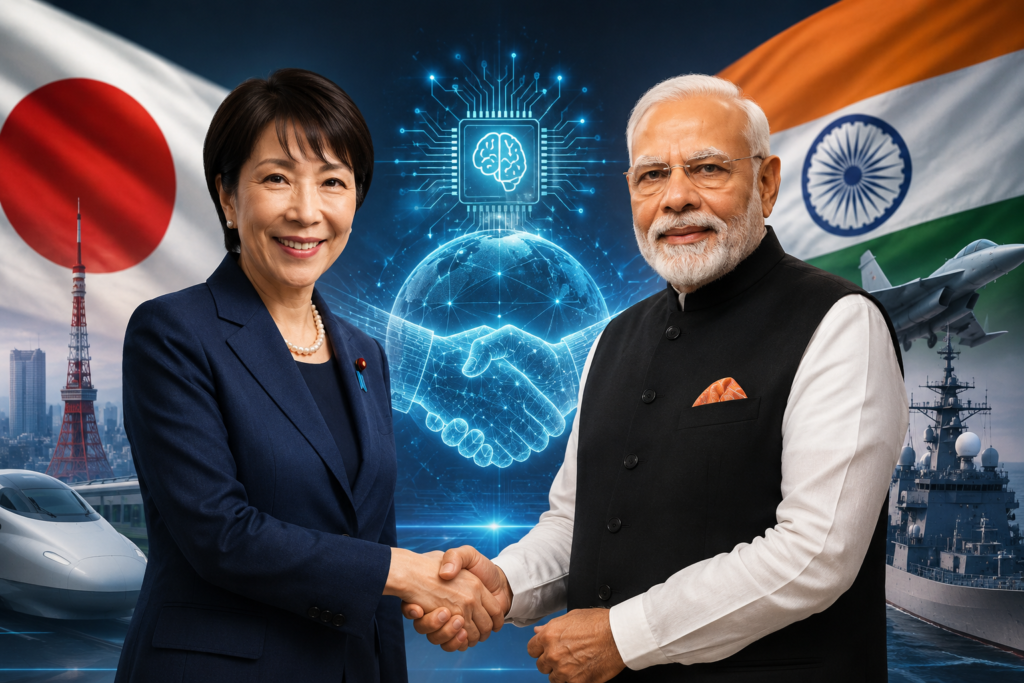
Japanese Prime Minister Sanae Takaichi and Indian Prime Minister Narendra Modi have announced new agreements to expand the India Japan partnership across artificial intelligence, defence technology, energy security, and economic cooperation.
The agreements were introduced during the 16th India Japan Annual Summit in New Delhi, placing Takaichi at the centre of major global discussions involving emerging technology and security. As Japan’s first female Prime Minister, her role in these negotiations represents a significant moment for women leaders participating in international policy decisions.
The summit brought new commitments between New Delhi and Tokyo, including AI collaboration, the first defence co development project, stronger technology supply chains, and energy resilience initiatives.
Digital Innovation Partnership
Artificial intelligence emerged as one of the key outcomes of the summit as the two governments adopted the Joint Statement on Cooperation in the Field of Artificial Intelligence.
The framework covers responsible AI development, research partnerships, digital infrastructure, and wider use of emerging technologies. Japan’s experience in robotics, precision engineering, and advanced manufacturing will work alongside India’s expanding software industry and digital ecosystem.
Technology security was another major discussion point. Through the Joint Declaration on Economic Security Cooperation, both sides outlined plans covering semiconductors, critical minerals, advanced materials, and secure supply chains. These sectors play an important role in industries including electronics, clean energy, and digital infrastructure.
Defence Technology Collaboration
A major outcome of the summit was the announcement of the first defence co development project between India and Japan.
The project focuses on the Unified Complex Radio Antenna system, known as UNICORN, for naval platforms. The technology integrates multiple communication antennas into a single structure, helping improve communication capability for modern naval operations.
New Delhi and Tokyo also agreed to increase defence equipment collaboration, technology development, and maritime security coordination. The collaboration adds a stronger security dimension to their strategic relationship in the Indo Pacific region.
Clean Energy Cooperation
Energy security became another central topic as leaders adopted the Joint Statement on Energy Resilience.
The agreement includes collaboration in clean energy technologies, green hydrogen, and sustainable energy projects. Both nations also discussed the India Japan Cooperative Biogas initiative, which focuses on expanding renewable energy solutions and supporting agricultural energy systems.
The discussions come as countries worldwide work to protect important industries from supply chain challenges. Critical minerals, semiconductor components, and advanced technologies remained priority areas during the summit.
Innovation and Investment Growth
Economic connections between the two nations continue to grow through manufacturing, technology, and industrial development.
Around 1,400 Japanese companies currently operate in India, showing the depth of existing business relations. India Japan bilateral trade reached nearly $27.5 billion during FY 2025–26, supported by investments across different sectors.
The latest agreements add new areas of collaboration for businesses working in artificial intelligence, advanced manufacturing, clean technology, and digital industries.
Sanae Takaichi Strengthens Leadership
Takaichi’s involvement in the summit placed her among global leaders handling some of the most important areas of international cooperation, including artificial intelligence, defence, and economic security.
Her participation also shows the increasing presence of women leaders in high level decisions involving technology, diplomacy, and global partnerships.
The India Japan agreements represent a major development in relations between the two countries, bringing technology, security, and economic priorities closer through stronger international cooperation.