
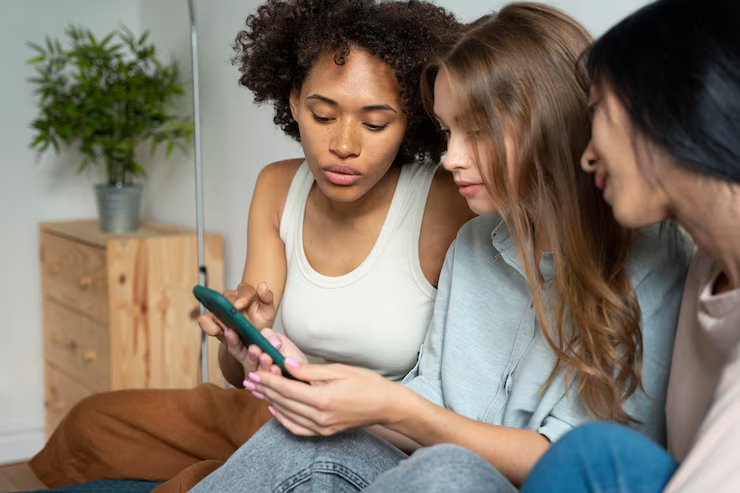
Women are becoming more careful about what they share online. Social media once encouraged people to share more of their lives publicly, especially during the peak years of influencer culture and personal branding. But rising AI abuse, cyberstalking, manipulated images, and nonstop digital scrutiny are changing how online spaces feel for many users globally.
The concern became more serious this month after regulators and cybersecurity agencies increased pressure on digital platforms to respond faster to deepfake pornography and AI-based harassment cases. Investigations across India, Australia, the United States, and Europe showed a sharp rise in fake explicit content created using publicly available social media photographs. Reports from organizations including UN Women and cybersecurity researchers have repeatedly warned that women remain the primary targets of AI-generated intimate abuse and image-based exploitation online.
Social media no longer feels like a space built only around connection or opportunity. It increasingly feels like an environment where visibility can quickly turn into emotional stress, judgment, harassment, or unwanted exposure.
Life as Public Content
Social media platforms reward attention. Users who remain highly active and constantly visible usually receive more reach and engagement. Over time, that created pressure to keep updating, reacting, sharing opinions, and documenting everyday life publicly.
Appearance, relationships, parenting choices, careers, and personal decisions are discussed publicly in ways that rarely stay private for long. Gradually, ordinary life started turning into content. Vacations became updates. Relationships became public discussions. Even taking a break from posting started attracting curiosity.
That nonstop visibility is creating emotional fatigue across digital platforms worldwide. A global online abuse survey released in 2026 found that nearly one in four women experienced cyberbullying, stalking, image-based harassment, or non-consensual sharing of personal content online. UNESCO also reported that 45% of women journalists and media workers had self-censored on social media because of online violence and harassment.
Constant online attention no longer feels rewarding in the way social media originally promised. Some of the most confident people online today are often the ones sharing the least.
The Deepfake Era
Artificial intelligence has transformed digital risks at a speed most platforms were not prepared for. A few years ago, oversharing mainly created concerns around privacy or reputation. Today, even ordinary photographs can be manipulated into fake explicit content within minutes using AI tools.
Research published by digital safety experts found that publicly downloadable deepfake models overwhelmingly target women and are becoming increasingly accessible through consumer-level AI tools.
Recent incidents pushed the issue back into global discussion. Police in Uttar Pradesh investigated a cybercrime case involving AI-generated obscene images allegedly used to blackmail a woman. In Australia, a court restricted a man’s access to AI image-generation tools after fake nude images of women were created using publicly available social media photographs. Similar exploitation cases involving AI-generated intimate abuse have also surfaced across Europe and North America in recent months.
Users are becoming increasingly cautious about:
- posting personal photographs publicly
- sharing live locations
- exposing family members online
- connecting personal and professional identities openly
- allowing unrestricted public access to private life
This change reflects growing awareness that digital spaces have become unpredictable in ways most users never expected.
The Rise of Controlled Visibility
Women are still building businesses, growing careers, networking online, maintaining friendships, and participating actively on digital platforms. But fewer people now believe every part of life needs permanent public visibility.
Private accounts, selective posting, smaller circles, close-friend communication, and controlled online exposure are becoming increasingly common globally. Instead of documenting everything publicly, users are becoming more intentional about what deserves visibility and what deserves protection.
This also reflects growing exhaustion with comparison-driven internet culture. Lifestyle competition, validation loops, aesthetic pressure, and productivity-based identity have emotionally drained many users. A recent UN-backed report found that more than 41% of women self-censored online to avoid abuse, while nearly one in five reduced professional participation in public digital spaces because of harassment and intimidation.
The issue is no longer only harassment itself. It is the emotional cost of always being publicly accessible.
Being connected no longer automatically means being public.
Privacy and Emotional Control
Privacy today is becoming less connected to secrecy and more connected to boundaries. Women are protecting not only personal information, but also mental space, emotional energy, relationships, and peace.
Social media normalized the idea that everyone deserves constant access to someone’s routines, opinions, emotions, and private moments. More users are now quietly rejecting that expectation. Public visibility no longer feels necessary for validation in the same way it once did.
Some of the most professionally focused and emotionally stable people online are often the least publicly visible. They still grow careers, maintain communities, and stay socially connected, but they no longer treat every experience as public content.
The internet spent years convincing people that attention equals influence. But confidence does not always require constant visibility. Sometimes real confidence is simply deciding what deserves public access and what deserves protection.
Conclusion
The internet is giving people more visibility than ever before, but many users are becoming more selective about how much of themselves they want permanently exposed online.
This is not about abandoning social media or rejecting connection. People are still creating businesses, building communities, maintaining relationships, and participating actively online. The difference is that more users now understand the emotional cost of unlimited visibility.
Privacy is beginning to represent something much deeper than hidden profiles or restricted access. It is becoming emotional protection in an internet culture built around exposure. In a world where online attention can quickly turn into judgment, manipulation, harassment, or exploitation, privacy is starting to feel more valuable than popularity itself.
Frequently Asked Questions
Why are more women becoming private on social media?
Growing concerns around AI deepfakes, online harassment, stalking, and emotional exhaustion are making many women more selective about what they share publicly online.
Has AI changed how women use social media?
Yes. AI-generated fake images and identity manipulation have increased fear around public visibility, especially when personal photos can be misused within minutes.
Does being private online mean being antisocial?
No. Many women are still active online, building careers, maintaining friendships, and networking digitally, but they are becoming more intentional about public access to their lives.
Why are private accounts and smaller circles becoming more popular?
Users are becoming emotionally tired of constant comparison, public judgment, and validation-driven internet culture. Smaller digital circles feel safer and more peaceful.
Why is privacy becoming more valuable than online attention?
Online attention can quickly turn into harassment, pressure, manipulation, or emotional stress. Privacy is increasingly being seen as a form of control, safety, and emotional protection.